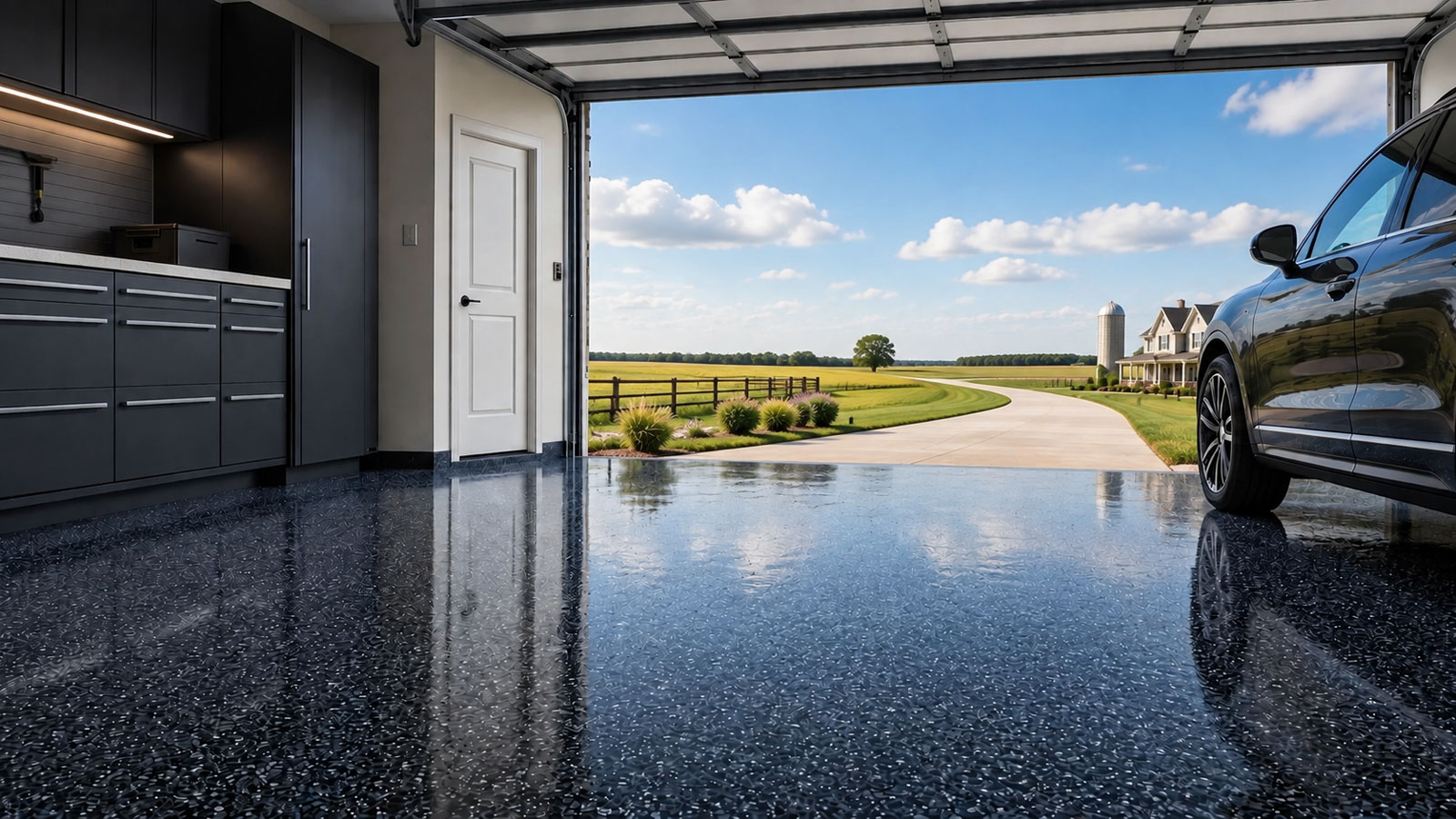
Garage Floor Coating in Lucas, TX
Floor Coating Services in Lucas, TX
Lucas has a distinctive rural-residential and drainage-planning setting on the eastern side of Collin County. Its 2023 Comprehensive Plan includes an entire Streets and Drainage chapter describing natural creeks, open channels and culverts. The document warns that some channels may remain wet for days after storms and notes the role of seasonal maintenance and the path water takes across adjoining properties. Those documented public conditions do not establish that any particular Lucas garage is damp, but they make lot-level runoff a sensible pre-coating question.
The plan also distinguishes FEMA floodways and 100-year and 500-year floodplain maps, while acknowledging that creeks not mapped by FEMA can still carry large storm flows. That geographical variation matters when evaluating a driveway threshold or detached garage, but it is not a prediction about private slab moisture. A property may have no water-entry history even when it lies within a town that plans carefully for drainage.
Lucas shares North Texas hot summers with neighboring McKinney and Allen. Sun-exposed garage entries, workshop use, oil and surface wear should be assessed before selecting epoxy, polyaspartic or a decorative-flake floor. Good preparation and a realistic curing window matter more than assuming every country-property garage needs one specific product.
Local Market Insight
Lucas's 2023 comprehensive plan specifically discusses creek channels, open drainage, culverts, FEMA floodplains and maintenance responsibilities. Individual garages still need direct evaluation for water and slab condition.
What Affects Garage Floor Coating Cost in Lucas?
A Lucas proposal should account for actual floor use and any entryway water history. Two garages with similar area can require different treatment if one has old paint, workshop residue, damage or an unusual threshold.
The city's drainage planning gives context for inspection, not permission to assume a water problem or charge for one without evidence. Ask for separate descriptions of preparation, concrete repairs and any exterior drainage concern.
- Prior surface treatment: An existing epoxy, paint or sealer may need removal, especially if peeling or incompatible. The substrate should be inspected and appropriately profiled.
- Concrete damage: Joints, cracks, pitting, repairs and movement can change labor. Active or structural problems must be evaluated rather than concealed by a decorative finish.
- Creeks and property runoff: Lucas documents open drainage channels and culverts, but actual lot drainage, gutters and garage threshold conditions determine whether water-related work is necessary.
- Garage and workshop use: Private workspaces can contain oil, tools and rolling equipment. Real use affects contamination removal, traffic demands, traction and cleaning requirements.
- Access and configuration: Steps, drains, extra bays, equipment and complex boundaries can influence labor beyond the simple floor area.
- System and return to service: Flake texture, UV exposure, coating layers and North Texas summer temperatures all influence product choice and cure scheduling.
Call for a clear, project-specific estimate—or request one online.
Lucas's Open Channels and Private Garage Moisture Questions
Lucas's 2023 Comprehensive Plan explains that creeks form natural stormwater channels and that open watercourses and culverts can experience significant flows during heavy rain. It also notes that stormwater may take several days to drain or dry out in some locations, and that maintenance responsibilities can involve adjacent property owners, the county and other agencies. These are unusually specific municipal findings, but they do not diagnose any individual home's floor.
When planning a coating, consider where water actually travels on the lot. Does the driveway slope toward the garage? Are gutters connected to a useful discharge route? Has water crossed a door threshold, or does a patch inside stay damp without visible rain entering? A coating installer may recommend testing or another assessment where symptoms justify it.
The town's planning distinction between floodways, floodplains and unmapped creeks also illustrates why an address should not be evaluated from a single generalized label. A property outside a mapped hazard area can still experience local runoff, while another near a watercourse may have a well-draining garage. Both require observation rather than assumption.
A coating is not a remedy for blocked culverts, poor drainage or structural movement. Owners should resolve those issues with appropriate specialists before spending money on a finish that cannot correct the cause. Contractors' estimates should separate any moisture evaluation from grinding, repairs, surface treatment and the decorative coating itself.
From Lucas Garages to Working Floors: Heat, Cleaning and Preparation
The Lucas comprehensive-planning materials address a landscape with varied roadways, creeks and residential land uses. That local context is distinct from the concentrated commercial districts of a large city, but it does not establish that any one owner keeps machinery or has a detached workshop. Instead, the homeowner should describe how the garage is actually used.
Parking only, tool storage, small engine work and frequent equipment movement place different demands on a floor. Oil or cleaners can penetrate unsealed concrete; heavy rolling loads and workbench activity can influence desired abrasion resistance and texture. An installer should explain the full coating system around those needs, not just show a color sample.
North Texas heat can affect application and cure, especially where sunlight reaches the outer slab while the back of the garage remains shaded. Ask how the installer will check temperature and follow the manufacturer's stated limits. Even a fast-curing coating requires a realistic schedule before vehicles and heavy equipment return.
A correctly prepared coating can make grit, spills and water easier to remove than bare porous concrete, but routine cleaning is still necessary. Smoother glossy finishes may be simpler to wipe, while textured flake can be better suited to wet footwear; each choice has its own cleaning implications.
Before a quote, document old coatings, cracks, prior patches and any recurring wetness. Ask for mechanical preparation, appropriate repairs, edge treatment, coating layers, final texture and a written return-to-use date. Those details make the proposal useful regardless of the garage's location in Lucas.
Frequently Asked Questions
Do Lucas creeks mean moisture will rise through my slab?
No. The city's comprehensive plan discusses creeks and storm drainage, but slab moisture is a separate property-specific matter. Check observed wetting, runoff and concrete condition before deciding on testing.
Can a coating repair water problems at a culvert or driveway?
No. Exterior runoff, blocked channels or damaged grading require other evaluation and potentially separate work. Coating can improve a suitable floor's cleanability but does not redirect stormwater.
Should an existing painted Lucas garage be ground?
A contractor should evaluate paint or sealer compatibility and condition. Incompatible or failing layers often require removal and mechanical profiling before a new system will adhere.
Is a textured coating better for a work area?
Texture may improve traction, particularly when water or debris enters. Balance that against cleaning, wheeled equipment and the intended chemical and impact exposure.
What should my Lucas bid include?
A useful estimate explains slab preparation, crack and joint repairs, contamination removal, complete coating layers, finish and texture, edge details and cure time for vehicle use.